Bargaining Session #10 - Summary
Days working without a contract: 44!
What does this mean? When the contract expires, its rules stay in effect so long as we are in negotiations. This means that contract wages will not increase until a new contract is in place. The new contract only applies once the entire contract is agreed upon and members vote to accept it.
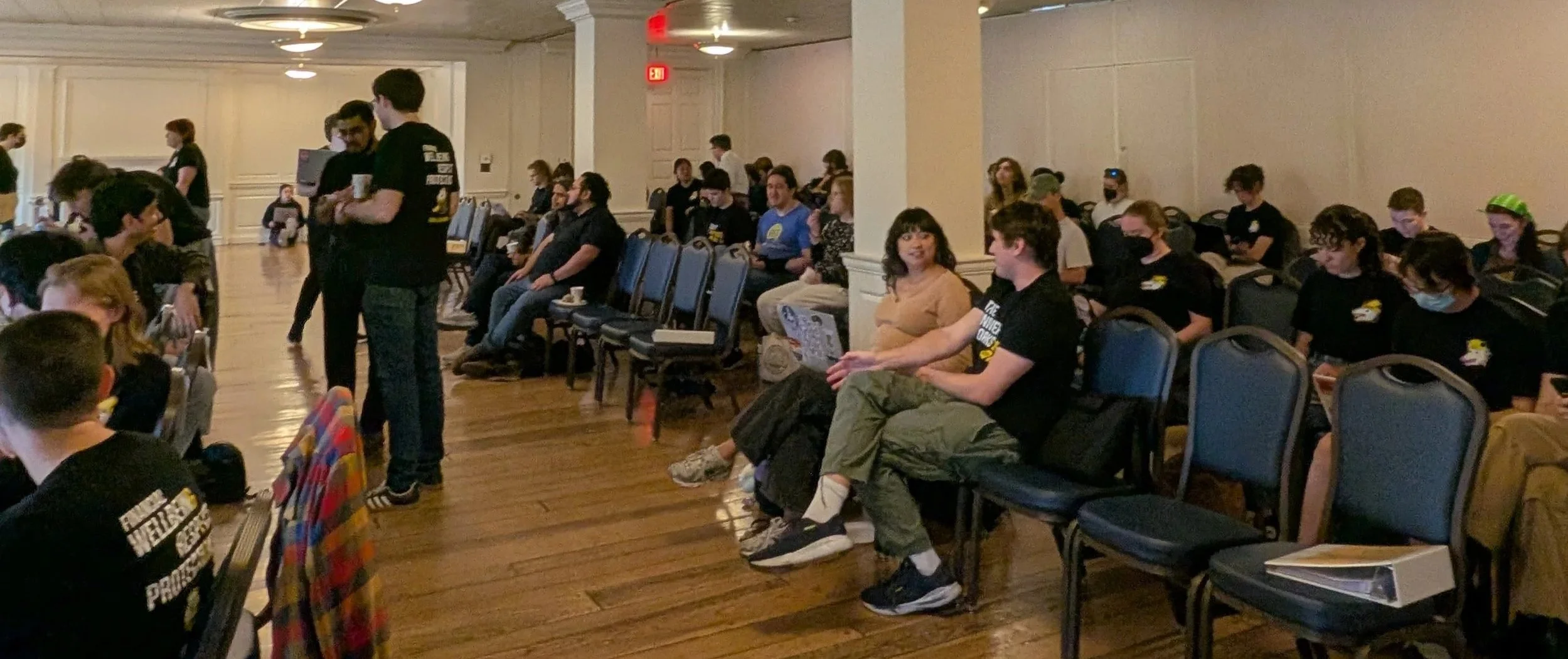
At Session #10, a whopping 140 GEO members attended! The GEO Bargaining Team (BT) continued to make good progress toward an agreement by presenting revised language while holding strong to what is most important to members.
For example, in GEO’s Hours of Work proposal, we include a sentence that requires a grad assistant's supervisor to notify the assistant before they are required to work outside of "standard University business hours" (9am-5pm). Originally, we proposed that the supervisor should notify the assistant "explicitly in the Offer Letter." In our revised proposal, we changed this to: "at least seven (7) calendar days in advance of the required work." This revision removes a part of the sentence that Admin refused to accept, while maintaining GEO’s intention to give assistants appropriate notice before they are required to work outside of regular work hours.
Now, the GEO members are eagerly awaiting a response from Admin on this proposal.
GEO presented three package proposals during the session:
Admin presented two packages:
Nondiscrimination & Miscellaneous Provisions (which included Use of University Resources, Union Rights, and Inappropriate Workplace Behavior but left out Immigration and Law Enforcement Matters and Artificial Intelligence)
Orientations and Training (countering GEO’s proposal)
Throughout the session, GEO and Admin exchanged several questions on various packages, but the administration's lead negotiator continued to claim that many of GEO’s proposals were permissive subjects (meaning that both parties may–but are not required to–negotiate them) instead of respectfully engaging with the substance of our proposals.
Nevertheless, GEO’s BT stayed firm, emphasizing that all our proposals–including increased transparency around grading of the Oral English Proficiency Exam–reflect the issues that are important to members.
In GEO’s proposal on Artificial Intelligence (in the article Miscellaneous Provisions), we propose that grad workers’ labor shall not be replaced by AI, and grad workers shall not be supervised or surveilled by AI. Admin outright denied that AI has an impact on grad workers. When GEO lead negotiator Cyrus Murray asked, “Does the University acknowledge that AI is substantially affecting working conditions currently?” the administration’s lead negotiator responded, “No. There's no evidence to support that conclusion.” This directly contradicts the lived experiences of graduate workers. When asked during caucus* if AI has affected their work, almost all grad workers in the room raised their hand.
*What is caucus?
Caucus happens when both bargaining teams go into recess to discuss the proposals on the table. Admin leaves the room, and GEO members debrief what just happened, ask questions, and work together to make important collective decisions on next steps. Caucuses can range from a couple of minutes to an hour or more. Learn about other bargaining-related vocabulary on our Bargaining Portal.
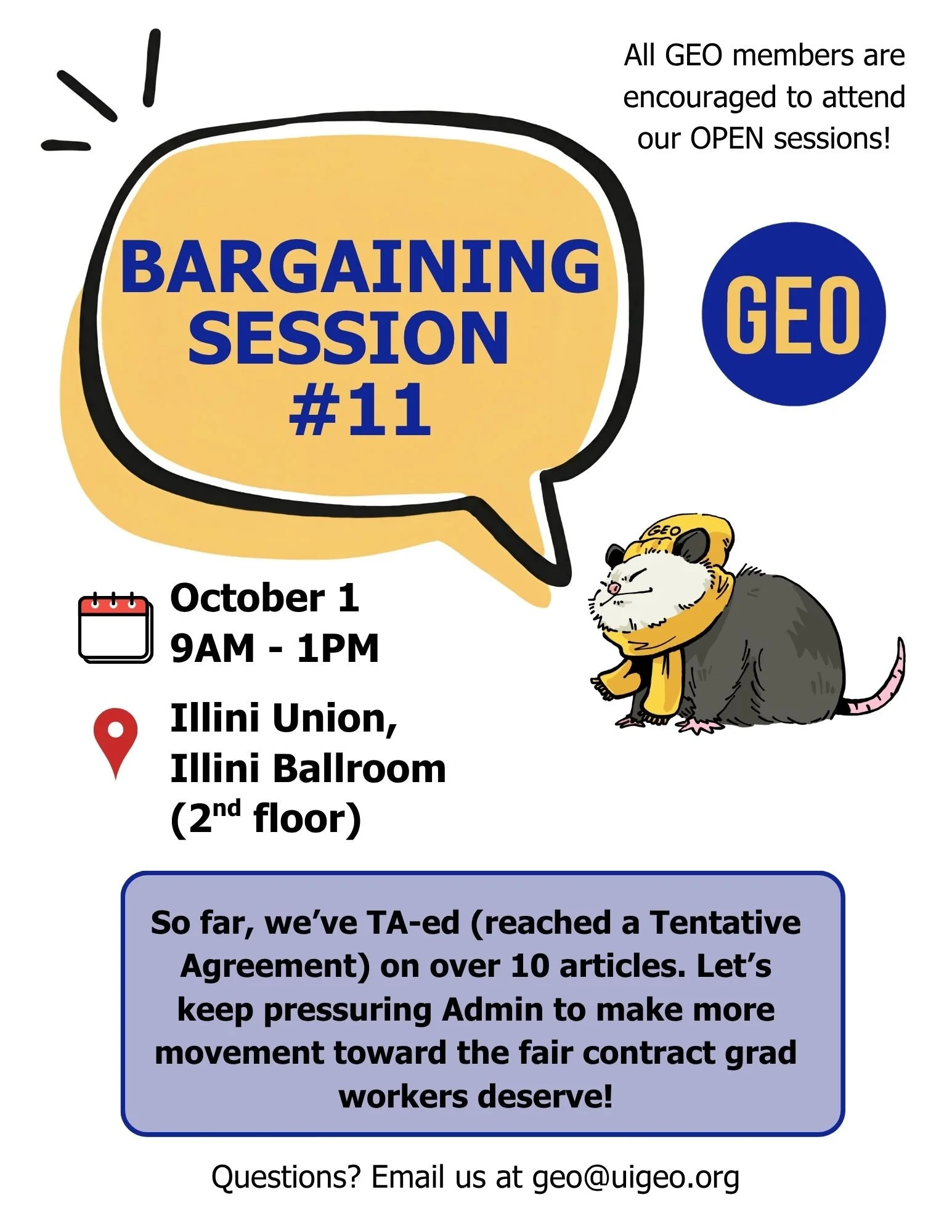
Join us in collectively improving our working conditions! Mark your calendars for the next two bargaining sessions: Thursday, 10/1 (9am-1pm) and Wednesday, 10/14 (1-4pm), both of which will be in the Illini Union Ballroom.
At the next bargaining session, GEO will continue to present proposals, ask questions about Admin’s proposals, and share member testimonials. We will also be holding a rally for international worker protections before the session on 10/14 at 12pm on the Quad outside Foellinger Auditorium.